Search This Blog

Friday, February 27, 2009

Let the Fast Begin


(This post is my sermon from Ash Wednesday Services at Peoria, Feb. 25, 2009)

Epistle: 2 Corinthians 5:20-6:10
Gospel: St. Matthew 6:1-6, 18-21

The first Sunday of Lent in 1983, I was asked to speak at an evening Lenten service of the campus Church at Findlay College. My subject was Fasting, since Lent is the traditional season for fasting for Christians.

In the congregation was Prof. Richard Kern, who taught History and Religion at the college. Prof. Kern was a minister in the college's sponsoring denomination and had been for quite a while.

After my sermon, as people were mingling, Prof. Kern approached me to chat. We talked for a little while and then he said something I've never forgotten. He said: "In nearly 30 years of ministry, this is the first sermon I've ever heard on fasting."

I was dumbfoundedly humbled and curious about why that would be. How could a man be in ministry for so long - how could he teach Religion for so long - and yet never hear a message about Fasting?

The interesting thing about fasting in the New Testament is that it’s not something that’s commanded – it’s something that’s assumed. Prayer and fasting are a duet that plays continually throughout the Bible, a melody offered to God by His faithful people.

Why is it that we pray so little and fast even less? I think part of it is because we don't really understand the importance of fasting. Often we have a hard time getting our hearts around the whole idea of prayer. To add "Fasting" seems nearly impossible.

Fasting has several dynamics that make it important for Christians:

1) Physical control
St. Paul states in several spots in the New Teatament: “I beat my body into submission” (in so many words). Taking charge of and being responsible for our physical being is a direct benefit of fasting.
* Do we control our bodies or do we allow our bodies to control us?
* Do we view our bodies as the dwelling place of the Holy Spirit or do we keep the Holy Spirit as a guest, occasionally visiting and not really at home?
* Fasting is also a means toward physical health that God intends for us by allowing our bodies to find balance from the excesses we often put them through.

2) Personal discipline
* As much as we appreciate the ideal of personal freedom, we don’t do well with it. Left to our own devices, we come to self-ruin and a life of regret. We become ‘gods’ unto ourselves with little use or need for the One God.
* Without personal discipline, we become our own standard of our own lives, with little sense of a common 'right and wrong'. This is the issue in the Old Testament Book of Judges: after the Hebrews spent years on a roller coaster of good and evil leadership, the Book concludes somewhat fataliztically: “every man did that which is right in his own eyes.”
* Personal discipline restrains our own desires in order to allow a sense of community with others. If we're only out for ourselves, what kind of world can we possibly hope to live in? Fasting is a simple, basic way of practicing personal discipline.

3) A matter of social justice
Isaiah 58 explains to us "the kind of fasting the Lord has chosen":
- to loose the chains of injustice
- to untie the cords of the yoke
- to set the oppressed free
- to share your food with the hungry
- to provide the poor with shelter
Why would this be something God is concerned about? I believe it's because fasting helps us to see people in the way God sees them (and us). Fasting brings about a means for understanding ourselves:
- in Christ, our chains of injustice have been loosed
- in Christ, our yoke of bondage to sin has been untied
- in Christ, we are set free from oppression
- in Christ, we share the Bread of Heaven
- in Christ, we find shelter from the storms of life


4) A matter of personal and spiritual integrity
All that “secrecy” the Lord talks about in Matt. 6 has a point: secrecy in giving,
secrecy in prayer, secrecy in fasting. The old adage is certainly true: "Your true character is seen in who you are when no one else is around.”

God sees the heart. He knows who we are on the inside, what makes us tick. God knows that public, conspicuous giving leads to pride. He knows that public, conspicuous praying leads to Phariseeism. He knows that public, conspicuous fasting leads to self-satisfaction.

Why a “Lenten Fast”?
The Church is a community – there are things we do together. We work together on orojects, committees, and helping others. We fellowship together. We worship together. We pray together. Why not ‘fast together’?

Lent recalls the history of the Bible and the Church. The 40 days remind us of
- the 40 days of flooding when God established the Covenant with Noah
- the 40 years of wandering in Sinai when God established the Covenant with Moses
- the 40 years of the reigns of King Saul, King David, King Solomon
- the 40 days of fasting the Lord undertook after His Baptism

The 40 days Lent remind us that the Church has always had group and personal discipline. In the early Church, Lent was a preparation time for Baptism. They used the time as a special teaching time for children. Importantly, Lent was a time for reconciliation for Church members who have lapsed. (We still see a remnant of this reconciliation practice in 'Forgiveness Sunday', the first Sunday of Lent.)

If you're out of practice, how do you begin a Lenten fast?

1) Self examination and reflection – asking God’s help
Tonight’s service: Prayers together that exalt the Lord
Time to pray the Lord’s Prayer in a reflective manner
Personal confession before God, privately
Affirmation of our Faith in the Nicene Creed
Participation in the Body of Christ through Communion

2) Ask yourself: What will honor the Lord?
Remember the Gospel: Fasting and prayer are for God alone to see. No selfish motives: not fasting to lose weight or fit into a dress, and not to draw attention to yourself

3) Ask: What does God want you to do?
If we can try to discern what God wants for us in a small matter like fasting, we will learn the spiritual skills for understanding His Will for us
Early Church Tradition – fast from foods: meat, cheese, dairy, eggs, fish
Western tradition – fast from meat, then meat on Fridays, then meat on Fri. in Lent only
Bible: Fasting usually referred to abstaining from food
What are you unwilling to surrender? This is probably what you should fast from. Ask the Lord how can you turn it over to Him?

4) Be realistic. Accept this as a discipline with joy. Find a way to redeem it. Karen and I have a friend who fasted from chocolate each Lent and gave the money to Church. Some sacrifice a meal out each week and giving the money to a mission. Remember that discipline is corrective, not frustrating – what will help provide correction you need?

Ash Wednesday is a time to start –
- we are beginning together
- we are here for one another
- we will grow in our faith together as we look forward again to a Holy Easter

So, let the fast begin!

Sunday, February 22, 2009

The Last Judgment


The picture above is of the shrine built on the Island of Patmos, where St. John received the Revelation of Jesus Christ (now the last book of the New Testament). Patmos is located in the Aegean Sea, off the coast of what is now Turkey.

Epistle: I Corinthians 8:8-9:2
Gospel: Matthew 25:31-46

I have to confess: I take advantage of God's grace.

Some people might say I'm overly self-critical (and they would be right). I know that I'm a master at second-guessing myself and I spend an inordinate amount of time thinking that things might have been different if I'd only done 'this' instead of 'that'.

I take advantage of God's grace in the same way I take advantage of the fact that there are too few deputies on the county back roads: I drive faster than I should, hedging my bets that I won't get caught.

I take advantage of God's grace by overlooking aspects of my own life that I think God would over look, too. How bad can a short burst of temper be compared to all the abortions being committed in the world? So what if I swear under my breath; at least I don't have a meth lab in my basement. Why would God care that I waste material things? He most certainly cares more about the sweatshop women and children that make them.

Maybe you're in the same boat as I am. You and I wouldn't be alone. In our culture we have a tendency to wink at sin. We want to permit things to happen because we know that we want the same leniency given to us.

This general tendency in our lives makes it difficult for us to cope with one of the most certain tenets of the Christian faith: "He will come again with glory to judge both the living and the dead."

This is the last of the three-Sunday season before Lent (called the "Triodion") and it is called Sunday of the Last Judgment. The first two Sundays are shining examples of the grace of God: the account of the Pharisee and the Publican and the parable of the Prodigal Son. And now, seemingly out of nowhere, comes the narrative of the Last Judgment.

These three passages are actually a perfect match. People like me, who take advantage of God's grace, need a reminder that there comes a time when the rubber meets the road. God isn't some sort of divine enabler, permitting us to go on indefinitely in our self-destructive behaviors.

This is actually the message of the parables of the Pharisee and Publican and Prodigal Son, as well. The unspoken story line of the former is the fact that the Publican had come to a place in his life where he needed to repent. The parable compares his attitude with that of the self-righteous Pharisee, but the truth is that somehow, somewhere, he got to a place in his life where he begged the Lord: "God, have mercy upon me, a sinner" (Luke 18:13). Likewise, the Prodigal Son finds himself covered with the consequences of sin before he finally rehearsed his petition: "Father, I have sinned against heaven and against you. I am no longer worthy to be called your son" (Luke 15:21).

No one likes to be judged. No one wants to face the consequences of what we do (or don't do). Everyone would like to believe themselves to be their own moral and spiritual standard and, as such, there is no room for anyone else to judge us.

In this sense, we are exactly like the sheep or the goats in today's Gospel reading. There is very little difference in the general composition of sheep and goats. They may have marks or body structures that set them apart from each other, but essentially they are exactly the same as every other sheep or goat.

They eat. They bleat. They herd. They breed. They give milk.
They taste good when roasted with some savory herbs.

Sheep and goats can't judge one another's actions because they feel no moral or spiritual obligation for one another. In fact, sheep are so self-consumed that they will run from a predator as a herd until one is caught, then watch as the predator consumes the caught animal. No ovine relief effort is mounted. No special offerings collected for the orphaned lambs. No awards for volunteer sheep hours served. As animals, they have no will to choose their own way or God's way.

The context for the Last Judgment is aptly put among sheep and goats. First, we see that the sheep and goats have no idea of when the judgment will come. Second, we see that they have little understanding of the reasons for judgment. And third, they are not judging one another; this is left to the Shepherd.

A quick reminder: The account of the Sheep and Goats is the end of a private session the Lord conducts with His Disciples that begins in Matthew 24:3, in response to a question from them. "What will be the sign of your coming and of the end of the age?" Christ is clear through the rest of Chapter 24 than no one will know when the judgment comes, only that it will come.

When we know judgment is coming, we prepare. I have worked in the health care field long enough to know that when a state survey is expected, there is a tendency to 'straighten up and fly right'. Even at Timbercrest, where I work, and where we have deficiency-free surveys consistently, there is a mild anxiety that settles in, knowing that we'll be inspected at at any moment. Records are re-read to be sure they're in order. T's are crossed and i's are dotted, just to be sure we're ready.

In the public schools, knowing that ISTEP testing is coming, the unfortunate trend has been to 'teach to the test'. But who can blame them? When we know that 'judgment' is coming, we get ready for it.

The Lord has higher expectations of us. We are not told when the judgment will come because His expectation is that we should be ready for it at any time. We are told to love our enemies and pray for those who persecute us, not to wait until we know He's coming, then do it. We are told to love our neighbors as we love ourselves, not to wait until we meet them in the line on judgment day.

Judgment may come to us in two ways. The first, as the Gospel tells us, is at the Last Judgment, a day and time unknown in the future, when all of humanity is judged by God. This final judgment is what St. John the Apostle witnessed in his Revelation of Jesus Christ. This day has been anticipated by Christians from the first century to today. It is the day we anticipate in hymns like this one:

When the trumpet of the Lord shall sound,
And time shall be no more,
And the morning breaks eternal bright and fair;
When the saved of earth shall gather
Over on the other shore,
And the roll is called up yonder, I'll be there!

The second means of judgment somes to us at Death. As St. Paul tells us in Hebrews, "Just as man is destined to die once and after that to face the judgment, so Christ was sacrificed once to take away the sins of many people; and He will appear a second time, not to bear sin, but to bring salvation to those who are waiting for Him" (Heb. 9:27, 28).

This 'destiny' for death (or, as the King James Version puts it, our "appointment" with death), is something we simply can't put off. Try as we might, death awaits each of us, and an account will be given before God of what we've done with our days, who we've become in the course of our years.

The time of arrival at our destination is only known to God, only to be determined by Him. This is a significant part of the reason that abortion, murder, suicide, and other man-made ways of taking another's life are wrong. If we take matters into our own hands in creating death for another, we assume a role that belongs uniquely and sovereignly to God.

What would you do to change your walk with Christ if you knew He was coming tonight? Why wait until judgment? Make the changes now, and live prepared to meet Him.

A second aspect about the Last Judgment is that the sheep and goats have little understanding of the reasons for judgment. After the Shepherd has pulled His sheep to His right and has blessed them for their lives, they still ask, "When did we do these things?" Likewise, after the goats on His left are condemned to eternal punishment, they ask the same thing, "When didn't we do these things?"

One of the nicknames that I have hoped to try and shake some day is "Instant-judgment Daniels." I often jump to conclusions about people based on their behavior or their outer appearance or their apparent lack of common sense or their inability to agree with me. I have criteria for judging people that is usually petty and insensitive.

God's judgment is based on compassion, love, grace and care. In Matt. 25:34-36, we read that God cares for the hungry, the homeless, the naked, the sick, and the imprisoned. God doesn't ask us to analyze or rationalize how people got hungry, or homeless, or naked, or sick or in prison. He simply cares that we care.

I believe the reason for this is that short-sighted human judgment comes when we begin to worry about how people get to where they are in life.
"She'd have enough food if she didn't waste her money on cigarettes." Perhaps cigarettes are her coping mechanism for a lifetime of abuse and her emotions trump her stomach.
"If he'd quit gambling he'd have enough to pay his rent." Maybe desperate life circumstances drove him to gamble in the first place. His plant closed. He was robbed. His family fell apart.
"They deserve to be in there for what they did." In truth, don't we all deserve punishment for the things we've done wrong?

God asks us to leave the affairs of the lives of others to Him. It is up to us to demonstrate His love and compassion to people, regardless of their circumstances.

Like the sheep and the goats, we may not understand this rationale about God's judgment, until we realize that we are subject to it as well. Are you (and I) willing to be subject to the judgment of others? Shouldn't we be more willing, more hopeful, in leaving our lives in the hands of God's goodness and compassion.

Finally, it's important to note that the sheep and goats aren't judging one another. That is left to the Shepherd. As I mentioned earlier, sheep and goats (and other animals) are remarkably self-absorbed. Even the most altruistic of animals - our pets - have to be trained to be so. And, given the chance, they'll fend for themselves every time.

I heard a speaker about 22 years ago talking about Christians in their role as servants. He said something I've never forgotten: "When we are busy serving our fellow man, we don't have time to judge him."

To me, this is one of the kernels of Christian faith. Of all the descriptive metaphors used of the Lord's disciples, not one of them is as a judge of anything. We are branches of the vine, servants (faithful and unfaithful), stones in His temple, etc. But we are never in a place of judgment.

Sheep in a meadow would only be able to judge other sheep in their same meadow because they have not been in any other meadow. Their perepective of the lives of other sheep is myopic, skewed only to how the other sheep in the meadow have treated them. Who got to the good clover first? Who stood where in the snow and rain? Who has what number on their ear tag?

It takes a shepherd to keep the fences mended, the wolf at bay, the hay stocked and stacked. It takes a shepherd to be aware of the conditions outside the meadow and to prepare his flock for them. It takes a shepherd to tend sheep that are ill or metastasized or orphaned or hungry, because won't - and can't - do it for each other.

Likewise, Jesus Christ in His place as Judge at the Last Day is the One Whose perspective sees beyond our own life's 'meadow'. He understands us and why other sheep may get the good clover before us. He sees when we're left standing outside the sheep pen in the rain and he knows how or why it happened. He sees 'wolves' that we are completely unaware of because we are so pre-occupied with our own concerns.

As we prepare to keep a meaningful and holy Lent, keep in mind God's Judgment. However you observe Lent - with fasting or abstinence, with added devotion or discipline - remember that your Shepherd is Jesus Christ and He has great compassion and care for you.

Tuesday, February 17, 2009

The Prodigal Son


On the Orthodox calendar, Sun., Feb. 15 was the Sunday of the Prodigal Son. This is my sermon from that morning. The icon above depicts the joyful return of the son to his compassionate father.

Epistle: I Corinthians 6:12-20
Gospel: Luke 15:11-32

The parable of the Prodigal Son is one of the most popular of Jesus Christ's teachings. Who among us hasn't found ourselves at one time or another in the position of the prodigal? Or the older brother? Or the forgiving father? Who among us hasn't hoped for a home to go to when our lives have fallen apart? Who hasn't opened our hearts with forgiveness to someone who is truly sorry?

The Lord's words in this parable are so applicable to our human nature. Maybe more importantly, the parable reveals more about God's nature and mystery.

God is the Lord of grace and forgiveness. We may not see that sometimes. In truth, we may look at the Old Testament and think otherwise. Was it a God of grace Who...
...expelled Adam and Eve from Eden?
...witnessed the murder of Abel and cast Cain into the wilderness?
...destroyed the earth in Noah's flood?
...ransacked Canaan with Joshua's armies?
To read the history of the Hebrews and their Jewish descendants is to wonder where God's grace and forgivenss can be found.

There are a lot of people who think this way. They see violence and injustice, despair and disease, and ask: "How can a God of love allow all this to happen?"

I'm not here to defend God because God needs no defense. He is Who He is. In the parable of the prodigal son, the Lord gives us reason to believe and an avenue to understand that He is truly the God of grace, forgiveness, and love. Jesus Christ reveals this to us, not as a defense, but as a gift.

The obvious mysteries revealed are that God accepts the repentant sinner and celebrates his return home. God gives freely to His children because they are His children, not because of their merits. God allows us to squander the gifts of life because He knows we'll discover life's true value in Him. These are the obvious lessons and they are enough for us to ponder for a long time.

However, there is more. If we settle for the obvious, we will miss the subtle, nuanced, and priceless mysteries of God's nature.

Consider the fact that the father in the parable loves equally both the repentant son and the son who never left. His estate was permitted to go to both sons, not because one was good or the other was promiscuous, but because they were both his sons. His estate was for both.

You who are parents, don't you think the father in the parable had an idea that his younger son would wander? We know our children are bound for unique and different paths. Isn't it good to know that God also knows that His children will take unique and different paths?

Some of us will never stray from God. We may have minor infractions - a cuss word here, a short cut there - but over all, some will never stray.

On the other hand, some can't seem to stop straying. Like a smoker who resolves to quit on New Year's Eve and has a smoke after breakfast on New Year's Day, some of us simply can't seem to stay on the straight and narrow.

One of the things revealed to us in this parable is this: Being God's child is merit enough. Just as Proverbs reminds us that God causes it to rain on the just and on the unjust, it is equally true that He loves all His children without favoritism and without prejudice.

The prodigal son was loved by his father even when the son couldn't love himself. Whatever else was going through the prodigal's mind, as he wandered thoughts of his father's disapproval were most certainly a regular occurance. We see it in the path he chose. At first, arrogant and proud, the son ignores his father's disapproval and seeks his inheritance anyhow. As he spent his money on loose women, drunkenness, and debauchery, he certainly thought he was undoing his father's life.

His arrogance descended to self-justification when the young man's money ran out. He must have thought, "I can make it without the old man's help."

The futility of going on his own descended to desperation, a mode of survival: "My father hasn't approved of anything I've done so far, he's not going to approve of me now."

Desperation became defeat when the son became bound to eat with the pigs in order to sustain his body.

You and I know this cycle, don't we? We have been down this same path:
Arrogance
Pride
Self-justification
Desperation
Defeat
It is the universal human experience when we are left to our own devices.

In much the same way, we know that God loved the son who never left, even when he couldn't love himself, either.

He, too, was arrogant, likely gloating over the obvious folly of his younger brother. Didn't his younger brother appreciate what he had at home? Couldn't he see how the father's heart would break? Certainly he, as the oldest, would never dishonor the family this way.

The older son's arrogance also descended to pride. I imagine those first few weeks without his younger brother meant that the older's chores might have shone a little brighter. Little digs at his brother's wasting life came up at family dinners. Self-justification took shape in his own mind: "I am the good son, after all."

Self-justication spun down to desperation as the older son saw his father kill the fattened calf and send his best ring and robe to the returning younger brother. What's fair about that? How could he get away with it? Didn't the father know how foolish his brother had been?

The older brother's desperation finally spun down to defeat. The tone of verse 30 is clear: he was angry, frustrated, and disgusted with his father.

The path of both sons through arrogance, pride, self-justification, desperation, and defeat is a path that I'm familiar with, and I suspect you are, too. But always remember: Being God's child is merit enough. In His infinite grace and love, God cares for both we who wander and we who stay.

Another mystery of God that Jesus Christ reveals is that God gives us freedom to exercise our own will. The younger son knew full-well that is was rude and unconventional to ask for his inheritance early. (Would you have done it?) In asking, the younger son was exercising his free will; his will to go and be contrary to what his father wanted. In spite of the younger son's determined will, the father allowed his son the latitude to go his own way.

We may understand this better when we see our own behaviors in the same light. How often do we ask for our "inheritance" from God before it's time?
We want our prayers answered now.
We want our blessing now.
We will take from God whatever we can get, not the full inheritance He intends for us.
According to verse 13, the younger son took the money and ran. Could this describe your prayer life? "Yes God, I'll take your salvation. Yes, I'll take your kindness and love. But don't bother me with anything else."

Had the younger son stayed, he would have gained the life skills and wisdom of his father. He would have witnessed the finesse of his father's business. He would have watched his father age and he would have grown as his father matured. He might have followed his father's example, with a wife and sons of his own.

The son's loss in his short-sightedness wasn't only his squandered wealth but also his squandered life. In order to exercise his own will, the son lost the benefits of witnessing his father's will complete.

We also see this in the older son. In fact, the older son had strayed. He had the opportunity to gain the life skills and wisdom of his father. He witnessed the finesse of his father's business. He watched his father age and likely had his own wife and sons.

The older son's will was revenge. His own will was favoritism. His own will was fairness.

God will not force you to follow His will. God will not violate your will in order to accomplish His will. The way to gain God's true inheritance is to pray as we do each week: "Thy Kingdom come, Thy Will be done..."

Finally, the last mystery we're shown is God's unfailing compassion. Notice that the Lord doesn't tell us that the father spent all his days and nights looking for his wandering son. That would have been an act of enabling. He didn't track him down, send out spies, stalk his friends and messages. The father likely knew exactly what his younger son was doing: exercising his own will.

God's compassion is free enough to allow us our own way. As I Corinthians 13 states, His compassion "is patient and kind; it does not envy, it does not boast, it is not proud...it keeps no record of wrongs. It does not delight in evil, but rejoices in the truth. [God's love] always protects, always trusts, always hopes, always perseveres..."

Compassion is not a smothering desire to inhibit someone else. It is the action of love to be there when someone else falls.

Compassion is not a judgmental "I told you so." It is a generous "Here, let me help you."

Compassion doesn't see us covered with the soil of the pig sty; instead, it runs down the road to meet us, it brings the best robe, the brightest ring, and sets the table for a celebration.

We see God's compassion best in His own Son, Jesus Christ. In sending Christ for us, God didn't stop sin from happening in the world. He didn't make the Virgin Mary obey His will. He didn't dictate to St. Joseph the direction of the Holy Child's life.

Because God has compassion for us, He doesn't become an enabler, chasing us down, spying on us, and stalking us. He waits for us to come home, His home.
There is one Cross, not many.
There is one Calvary.
There is one Empty Tomb.
When we are lost and wandering, He draws us home by the Holy Spirit, with open arms ready to meet us.

The parable of the prodigal son is truly one of the most popular in Scripture. Through it we get a better glimpse at God's nature. We see that being a child of God is enough to merit His love and blessing. We understnad that God loves us enough to allow us to exercise our own will in spite of whatever consequences we may face. We see that God's unfailing compassion waits for us to repent to find our way to Him, to Calvary.

Who among us hasn't found ourselves in the position of the prodigal son?
Who among us hasn't hoped for a home to go when our lives have fallen apart?
Who among us hasn't hoped for forgiveness from God and man when we are truly sorry?

God is waiting for you.

Saturday, January 24, 2009

Rent This Video!


I don't recommend a whole lot of movies to people because I don't watch a whole lot of movies that other people enjoy :-)

However, I'd like to recommend and encourage you to get a hold of a copy of a documentary entitled: Expelled: No Intelligence Allowed. Hosted by Ben Stein (the guy who does the Visine commercials), this video raises the very valid issue that evolution is bologna.

I could go on and on about this, but the DVD speaks for itself. If you're concerned about the stifling grip that liberalism and atheism have on public debate and education, you'll want to pick this up. I've seen it available at Family Video Stores, through Amazon.com and at libraries.

You'll have your eyes opened and your faith strengthened.

Monday, January 19, 2009

Ten Bonuses of Rural Living


A year or two ago, our niece, April, had an itch to move to a small town. April was born and bred a country girl, the daughter of a hog farmer and a school marm, on one of those farm places where the phone company is from one town, the schools in another, and the post office is another.

However, she went to college at Butler (Indiana's answer to Yale*) in Indianapolis and never looked back. She became thoroughly urbanized, getting involved in things like 'sororities' and 'musical theater' and 'graduate school'. She married a guy who also left "Green Acres," and moved to a 'vinyl village' with her husband and two boys in an upwardly mobile suburb of Indianapolis.**

Anyhow, when the itch hit her, she decided to run her ideas by Karen and me. After all, we live in rural Indiana by choice. I'm sure to a girl looking to re-connect with her country roots, we must have appeared to be living the dream.

While helping April make her decision, I came up with some bonuses to rural living. I'd like to share them with you.

1) The Commute. When I drive to work, I drive 20 minutes through green fields, woods, over rivers and streams. I see wildlife - turkeys, foxes, deer, snapping turtles, quail. I don't have to drive to the country to see the changing colors in autumn. The sky is huge and there's little enough traffic to drive slowly and enjoy it.

2) The People. In rural communities, you can't really say anything about anyone because everyone is related to someone somehow. That may sound a little confining, until you realize that the converse is also true: people know you and care about you. They may know more about my business than I'd really like, but they also know enough to be there when I need them.

3) The Shopping. It's no secret that Wal-Mart is the great merchandiser in rural areas. However, they're not the only ones. There are still hardware stores, where the clerks know your name and have an idea of what you're after. TSC (Tractor Supply) and Rural King thrive and we have smaller, lesser known department stores: Alco, Pamida, Dollar General. Nothing beats filling the cart with bargains at Dollar General. We wear labels like Carharrt, Dickies, Red Wing and Harley-Davidson.

4) The History. Rural Indiana is dotted with accessible, living history. Cities put history in museums, but in the country, you can walk through cemeteries that are 150 years old; you'll recognize names that are still alive and vital in the community. You can see the houses that have hosted generations of the same family. There are places like the covered bridge (above) that you simply run across on a quiet drive on a Sunday afternoon.

5) The News. I was having coffee one morning in the restaurant here in Roann and the man at the table next to mine folded up the newspaper he had been reading. Mildly disgusted, he said to me, "There's nothing in this paper." "Isn't that why we live here?" I asked him in response. He agreed. It's true that no news is good news and I'd rather keep the things that make news at arms length.

6) The Perspective. It always cracks me up when I hear the national news folks describe a place like Fort Wayne (pop. 275,000) as a "small town." For us, Fort Wayne is the big city. Our town of 400 souls is big enough, thank you. We can find everything we need in the town where Karen and I work - pop. 6,000 - or in the county seat - pop. 11,000. Maybe the biggest effect this has on 'perspective' is in the statement 'everything we need'. One of the bonuses of rural life is that you go to the city and find that there's an awful lot of stuff out there you don't need.

7) Priorities. Living in the country means that there is distance between people and places and decisions have to be made with that in mind. When we go to town, we try to make it worthwhile. It's not like running down the block to CVS to pick something up. Rural living means that more time is spent at home and more time is spent with each other. Entertaining family and friends at home is still common. Most country people eat out, but we also put a premium on eating at home, too. (A phenomenon the New York Times recently labeled "eating in." Sheesh.)

8) Church. Christianity is still the norm in rural Indiana. We sometimes take it for granted. Even those who don't go to Church (and there are plenty of them) respect the Church and what it stands for. It sounds like a cliche, but we are indeed the people Mrs. Clinton indelicately described as holding on to our religion and our guns.

9) Sunrise and Sunset. The long black silhouette of the sunrise is the backdrop for my morning drive to work. Trees stretching up and out greet the pink of daybreak. Shadows of barns and grain bins break up the open spaces. But mostly there are open spaces. At sunset, the sky is so large that the moon is rising in the east while the sun sinks in the west. It happens every day and I can't get enough of it.

10) Soil. It seems that most people I know in rural Indiana have a connection to the soil. We plant gardens and flowere beds. We love the smell of newly plowed fields in spring. We talk about the weather, even if we're not farmers, because we know that things like rainfall and water tables affect farmers, and we all know them.

To my way of thinking, the benefits of rural living make this the best place to be.

* Butler is Indiana's Yale; the obvious 'Harvard' here is Notre Dame.
** They left the vinyl village a year or so ago and now live in a respectable tree-lined street, still in the 'burbs.

Tuesday, January 13, 2009

Praying for the New President


Unlike many other conservative Christians, I have never doubted the Christian faith of our new president, Barack Obama. I heard him share his testimony on NPR's "All Things Considered" one evening and I thought to myself, "I wish I knew more Christians who were as sincere and articulate about their faith as Barack Obama is."

As a conservative pastor, I have been inundated (as many people have) with concerns about the new president's connections to Islam, his former pastor Jeremiah Wright, and the liberal leanings of his denomination, the United Church of Christ. E-mails, web sites, mass mailings and phone trees have all done their best to impugn the faith of our new Commander in Chief.

But you would have had to have heard him on that radio program to understand where I'm coming from. Unlike many of Obama's speeches, that are long on rhetoric and short on content, the radio testimony he shared was deeply sincere. He hadn't been coached about his relationship with Jesus Christ. He hadn't run it through a focus group. He wasn't watching his words to avoid misstating something. It was simply, clearly, sincere.

That is why I choose to pray for him. I know that Mr. Obama and I don't agree on many things, especially abortion. But we also agree on a lot, especially the fact that he, as president, is still a subject of the God of Heaven.

I will pray for him as he makes decisions - the right decisions - about abortion. I will ask God to move his heart to keep tight restrictions on funding for programs that endanger human life from the moment of conception.

I will pray for his family. As President Bush stated (in a rare moment of eloquence), when the stress of being president gets to Mr. Obama, "he is only a 45 second commute from a wonderful wife and two beautiful daughters who love him dearly." They will need our prayers as they see their husband and father walk into the lions' den that is Washington D.C. They will need our prayers for protection: who of us would put our young children in harm's way the way the president's daughters will be?

Mostly, I will pray that being president will be an experience of humble service to God. It seems ironic to me that presidents most cherished by we conservatives (Reagan and the Bushes) are not known for their regular Church attendance, yet presidents reviled by many conservatives (Carter, Clinton and now Obama) are unflinchingly regular in their Church attendance. My hope is that the faith about which I heard Obama speak on the radio will be deepened, strengthened, and revived through his term as president.

Make no mistake about it, I have very high anxiety about our new preisdent. Unlike nearly everyone I talk to, I am not ecstatic about this 'historic occasion'. I am worried about the strength of our relationship with Israel. I am concerned that taxes will increase. I felt that President Bush's faith-based initiatives were good and should be expanded and I'm afraid Obama will end them. I am opposed to reinstitution of the military draft and gays in the military.

But I thank God for the United States and for the smooth transition of power. I believe that God's hand was in Barack Obama's election and that he is the right man for the hour, whether or not I agree with him (or he with me). If we believe the Bible, we will follow the direction of the Apostle St. Peter to "honor all men; love the brotherhood; fear God; honor the king" (I Peter 2:17).

So join me in praying for Obama and his family, won't you? And may these next four years will be years of God's blessing on our nation.

Friday, January 02, 2009

Going Public With New Year's Resolutions


It's questionable enough to make New Year's resolutions, but it's pretty close to foolish to make the resolutions public.

However, I am both questionable (at times) and foolish (much of the time), so I thought I'd share what I'm thinking about for 2009.

First, I'm making two personal resolutions. The first is to taper down my television viewing to just one hour a day. TV is a personal weakness and I have often neglected other things in order to accommodate my TV schedule. I don't have any delusions about eliminating TV altogether, but I really need to cut back. (The TV is off at the moment, thank you very much.)

The second personal resolution is to get my 50 year old physical and track my health better. There are particular aspects to the 50 year old physical that will make this difficult to accomplish, however, it needs to be done.

Next, I'm making two professional resolutions for my work at Timbercrest. The first is to finish the paperwork necessary for my National Certification. I don't know why this is so hard to do. It's just paper. But it's so easy to put off.

My second professional resolution is to take all my vacation time. And comp time. I am notoriously negligent of my own needs for rest, yet I preach it all the time to my staff. In 2008 I only took about two and a half of four weeks available to me and barely claimed the comp time I should have. The price has been excessive weariness and chronic ennui. The people who live at Timbercrest and the people with whom I work deserve better.

Next, I'm making two professional resolutions as pastor of Peoria Church. The first one is to try and better equip Church members for the disciplines of living the Christian life. I think this will mean better connecting both Word and Sacrament to people's lives, their families, jobs, homes, friendships, etc. In order to do this better, I'm going to have to work on this better myself.

My second pastoral resolution is related to my second Timbercrest resolution: taking better care of myself spiritually. To this point, my pattern is to get all spiritually fired up during the "fasting seasons" - Advent, Lent, Sts. Peter and Paul, and Dormition - and then let those times carry me through the rest of the year. Of course the problem is one of balance. So, I need to practice ways of maintaining a sense of spiritual balance all year. (I already know plenty of ways to do that - it's the practice of them that I need.)

Finally, and certainly not the least important, are my two resolutions relating to Karen. I'm listing these last because I think if I can make a dent in any of the ones above, then I'll be doing a lot toward being a better husband. Watching less TV, keeping better care of my health, taking more breaks from work, and developing better habits spiritually should all help in the husband department.

But I have two specific resolutions relating to Karen. The first is to be more open to her needs for quiet time. I tend to want to fill the empty spaces with jabber. I need to develop more respect for her needs to unwind from work, where her full roster of special needs children keeps her busy.

My second "Karen" resolution is to keep up with the garden this year. In the last several years, our perennial flowerbed has been a nice way of beautifying our home, but in 2008 I let it get away from me. It became a large weed bed more than anything. So this year, it's back to the flowers. I want to create a better quiet space for Karen outdoors - she loves to sit on the swing and enjoy the view.

So that's it. "No resolutions for your kids?" you might ask. Nope. I think if I can work on any one of these, I'll be going the right direction to being a better father, too. And besides, they're adults now: they should be making resolutions for me, right? :-)

Monday, December 29, 2008

Remembering My Baptism


I don't remember my first baptism. I was about five months old (January 1959) and it is likely that it was a simple affair in St. Andrew's Episcopal Church in Elyria, Ohio. I've reconstructed the scene in my own mind many times over the years:

I was the first grandchild on both sides. My mother's mother was very ill and Mom's dad, Grandpa Charlie, took care of her. My father's parents were staunch members of St. Andrew's. My godparents are George and Linda Dellinger, family friends. With my parents and Fr. Russell Hargate, the ten of us participated in a quiet, simple ceremony in the Nave, using the 1928 Book of Common Prayer.

I do remember my 'second' baptism. I was an adult (19 years old) and had a religious experience in college. I felt compelled to be baptised again, partly due to the theology of the Church I was attending at the time. It taught full-immersion adult believer's baptism. The pastor was Moses Vegh, a charismatic Hungaro-Canadian who served as pastor of what was then the largest Protestant Church in Findlay, Ohio, where I lived.

"If you don't remember your first baptism," Moses Vegh told me, "it probably didn't mean anything to you." So I suited up in the white robe provided me by the Church and went into the tank. Moses didn't actually put me under, an anonymous elder of the congregation did. Coming out of the water, I was anointed with oil after which I was expected to speak in tongues (which I didn't).

I'm 50 years past my first baptism and 30 years past my second one. I've come to the conclusion now that I don't understand either one.

Baptism isn't something to be done for a level of understanding. Baptism is an action of the Church to imprint on us the image of Christ. Understanding has very little to do with it: Faith has everything to do with it.

When I was an infant, the faith of my parents, grandparents, and godparents was that I would be "received into Christ's Church and made a living member of the same."

When I was a young adult, it was an act of my own personal faith, the fruit of a re-discovery and religious epiphany in my college years.

Now as a pastor I perform the rite of baptism with the faith that God knows the one being baptized far better than I do, and far better than they know themselves. I've adopted the phraseology of the Orthodox Church in the ritual because it better expresses this point of view: "You are baptised in the Name of the Father and of the Son and of the Holy Spirit." Not an action of the pastor, not an action of the water, but rather an action of faith. "You are baptised..."

It has nothing to do with me as the baptizer or the person in the water. It has everything to do with God and what He does through the miracle in the water. It is God Who draws the soul to baptism, God Who makes the waters holy, God who does the baptizing and I am His unworthy servant.

As we approach Theophany and the commemoration of Christ's baptism (Jan. 6), I remember my own experience of Baptism and I pray that your baptism may be fresh again to you and that you will again see the image of Christ that you bear in your own soul.

(Pictured above is Seven Pillars, the site of many of our Peoria Church baptisms.)

Sunday, December 28, 2008

Barack Obama and Holy Innocents


Today, December 28, Christians remember the tragic slaughter of the innocent children of Bethlehem (Matthew 2:13-18). They are certainly the first martyrs of the faith, whose commemoration follows the day after we remember the first martyr of the Church, St. Stephen.

The innocent children of Bethlehem did nothing against wicked King Herod. Their mothers had done nothing. Their fathers did nothing.

Yet, for the pursuit of his own vainglory and self promotion, Herod massacred them all, in an attempt to eradicate Bethlehem (and his realm) of the true King of Kings Who had just been born there.

It is interesting to me that the newly elected president, Barack Obama, has promised to renew the slaughter of innocents as one of his first actions as president. He has promised to release federal tax monies to fund abortions. He has promised to fund research using stem cells that will cease lives of unborn children. He has pledged to make abortion safe and legal, for the sake convenience against an 'untimely' pregnancy.

He has even said of his own daughters that he wouldn't want to "punish" them with a baby, were they to become pregnant at a time inconvenient to them.

It seems that King Herod is arising once more to the throne.

We are reminded again in the Old and New Testaments, in the writings of the early Church, and in the consistent centuries-old witness of the Church, that the life of a human being begins with the miracle of conception.

And we are reminded again on this day marking the innocent death of the children of Bethlehem, that rulers can be ruthless in their self-promotion, sparing no one, even the souls of the most defenseless.

In the Communion Liturgy we pray for the president, no matter what his politics, that God will give him the ability to lead justly and fairly. Our prayer for Barack Obama should be the same, and that he will see the injustice of abortion and keep the lives of the innocent unborn protected.

Saturday, May 24, 2008

Memorial Day


Yea, though I walk through the valley
of the shadow of death
I will fear no evil
for Thou art with me
Thy road and Thy staff, they comfort me.
Psalm 23:4

I never had to enter a military recruiting office.

Actually, I have never even been in one, whether I had to or not. But if I had, I think it would be like walking into the 'valley of the shadow of death'.

When I was in high school and college, there was no registration for the draft. President Ford (a Republican) had dismantled the draft after the end of the Vietnam War. By the time registration for the draft was re-instated by President Carter (a Democrat) I was too old to do it.

I have often wondered what it would be like to be one of those men (or women) who took that step - either of their own free will or by government compunction - to enter the armed forces.

I have often wondered what goes through their minds as they talk with the recruiters about 'seeing the world' and 'vocational training' and 'educational benefits'.

I've often wondered how many of them think, "Some day I'm going to put my life on the line for some obscure, middle-aged, overweight pastor, so that he has the freedom to preach the Gospel or write his books or post to his blog."

I also wonder if I would do the same.

I tell myself I would. I would lay down my life for the Lord any day (or so I tell myself). I would definitely lay down my life for Karen and the kids . . . again, so I think. I have friends and family, Church members and good causes I would go to the death for. Probably.

But I've never actually had to do it.

That's what makes Memorial Day so stunning to me. It's a day to honor men and women who have actually laid down their lives for me. I'm an unknown to them, yet they put on a uniform and enter harm's way - for me. They put their lives on hold for me. They surrender their dreams, their families, their relationships, some for a few years, some for a lifetime, for me. Sadly, too many surrender their lives, also.

A week ago, our Sunday School children placed flags on the graves of veterans in the Peoria Cemetery. As we walked up and down the rows of tombstones it re-occured to me that soldiers have been doing this for a long time. The Civil War soldiers couldn't have known that 150 years from their conflict, Sunday School children would still be worshiping the Lord near their final resting place. The Spanish-American War vets, the 'Doughboys', the veterans of WWII, Korea, and VietNam all stood their ground in a way that I can only wonder about.

So this Memorial Day weekend, as I hang the flag from our front porch, I join a grateful nation, thanking the men and women who have laid down their lives for our country. And I am grateful for those who stand to day, in the valley of the shadow of death. May God protect them until they come home.

Especially, thanks to the men from the Peoria Church family serving today:
Craig Berkhiser (grandson of Marge Johnson)
Mark Hults (son of Shirley Mills, grandson of Gene and Marcille Ranstead)
Christian Ensign (grandson of Jeanette Ensign)
Russell Marschand (son of Debbie Marschand, grandson of Jeanette Ensign)
Steve Shiholt (son of Pauline Shinholt)
Chad Troyer (son of Dale and Carla Troyer, grandson of Clara Bowman)

Tuesday, April 10, 2007

Xristos Anesti


Christ is risen!

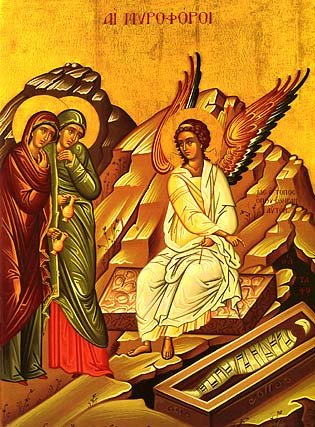
The icon above is a picture of the women bringing herbs and spices to embalm the Body of the Lord on the first day of the week. Obviously, the women had a surprise waiting for them when they arrived in the Garden . . .an Angel announcing:

"Xristos Anesti! Christ is risen!"

After the gloom of that first Maundy Thursday and the darkness of that first Good Friday, the myrrh-bearing women little expected to find a joy-bearing Messenger.

He is risen, indeed. Alleluia!

I had a particularly meaningful Lent this year. I tried to maintain a good fasting discipline and I stayed away from the Internet as much as possible, except for e-mail. I didn't listen to the radio at all and that was harder than the internet - I'm a news junkie and being away from NPR for a month and a half was nearly my undoing.

Three things that made this Lent particularly special were writing projects I undertook.

The first was to finish my book on the founders of Peoria Church, Benjamin and Anna Hahn. It's a charming story and now all that's left to do is to find a publisher (in my spare time!). It's really a pioneer story, set in the 1840's - 1890's, a journey that was as much toilsome as it was spiritual. When I find a publisher, you'll know.

(And I hope you buy a copy, too!)

The second writing project involves beginning a book about another pioneer family, my in-laws. Chester and Angie Clark aren't quite like the Hahns, but their story is fascinating, too, of a southern family who came north during the depression and made a life as farmers and factory workers in rural Indiana. I was able to spend a day with my mother-in-law getting some background things.

The third writing project I'm keeping under wraps for now, but it is one I'm very excited about. I'll keep you posted :-)

My good friend, Pastor Tim, has spurred me to get blogging again, too. He's started a blog for his Church and I thought it may be time to resurrect The Country Parson, too. (Tim's blog has a great name: 'Neadertheology'. I love it!)

Paschal blessings to you and yours!

Saturday, August 26, 2006

Celebrating 150 Years


This fall, the congregation I serve as pastor will be 150 years old. It's a momentous occasion for our little fellowship.

Founded in the fall of 1856 by a pioneer family, the Church has changed a lot over the years. The founding family, the Hahns, built a log cabin-style building on their land for worship, because there were no other Churches in the area of Peoria, Indiana. Preachers of several different denominations and styles have been there, including Miami Indian preachers.

It wasn't until the 1910's that they finally settled on a small Methodist denomination. This group became part of the Methodist Episcopal Church in 1939 and the United Methodist Church in 1968. The Church became an independent community Church again in 1997.

The building was remodeled in 1914 with stained glass windows added among other things. In 1962, the federal government began the Mississinewa Reservoir project. The 60-ton structure was dragged across a corn field to it's present site, about 1/4 mi. from the original. New pews, pulpit and communion rail were added, but the basic Church looked very much the same. In 1978, a steeple was put on. In 2005, a nursery and upstair restroom were added.

More important than the building is the people of the congregation. It is a unique and amazing group. Some families have ties to the original founding congregation. Others are newer but feel right at home. There are some who are life-long Peorians and others who are former Brethren, Catholics, Episcopalians, Quakers, Methodists, Baptists and more.

Jesus Christ said, "By this shall al men know you are my disciples: that ye have love, one to another." This is certainly true of Peoria Church. We love each other, which means all sorts of things. Of course we worship and pray together, but we also laugh together, cry together, disagree with each other, help each other - all of it because we love each other.

If you are reading this blog, you are welcome to attend any of the Sesquicentennial Events scheduled for Sept. 10. Here is the schedule:

9:00 - Worship

10:15 - Old Fashioned Hymn Sing

11:30 - Hog Roast - Free for everyone!

1:00-3:00 - Old-time Games and Recreation

3:00 - Children's Puppeteer program

4:00 - Gospel Concert - "4 For Him"

5:00 Cutting the 150th Birthday Cake

Thanks for your support and prayers for Peoria Church.

Sunday, August 13, 2006

Mary the Under-rated?


What would you do if you knew a person who was completely sold out to God, who staked her reputation and her life on her faith, who followed Jesus Christ diligently, whose heart broke at the Crucifixion and rose to ecstatic elation at the Resurrection?

What would you do if you knew such a woman? Would you ignore her? Would you not believe her? Would you say, "that's nice" and pass her off as a fanatic or fringe group member?

Such a woman is Mary of Nazareth, justifiably known as the 'first to accept Jesus Christ.' Mary is the woman who accepted the call to be 'Theotokos' or "God-bearer." She didn't do it with pride or with thoughts of self-advancement: To the Angel she said, "Behold the handmaid of the Lord; be it unto me according to Thy word."

When she witnessed the miraculous testimonies about her newborn Son, she "pondered all these things in her heart."

When she attended the wedding feast at Cana and witnessed Jesus Christ's first miracle, she said, "Whatsoever He says to you, do it."

Unlike eleven of the twelve Apostles, Mary stood with her Son until His death on the Cross.

Without the fear that kept the Eleven in the Upper Room on the Morning of Resurrection, Mary went to the Garden to tend her Son's Body, only to witness the glory of His Resurrection.

Yet for all this, the Virgin Mary remains under-rated, misunderstood, and in many circles, nearly ignored. Certainly we can echo the words of John the Baptist's mother Elizabeth who said, "Blessed are you among women and blessed is the fruit of your womb. And how is it that the mother of the Lord cometh to me?"

Mary is a woman we need to know better. As the Angel told her at the Annunciation, Mary is "blessed among women" because of her willingness to bear the Son of God. In her wonderful Magnificat, Mary sings, "my spirit hath rejoiced in God my Savior, for He hath regarded the lowliness of His handmaiden."

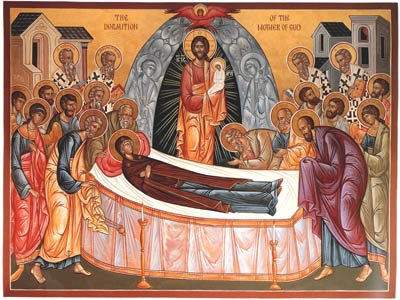
Tuesday, August 15, is the observance of the 'Dormition of the Theotokos.' It marks the 'falling asleep' of Mary and her entry into her eternal reward in Heaven. Mary's death is a foretelling of our own deaths. It reminds us that an eternal reward awaits us when we 'fall asleep' in the Faith.

On Tuesday, take a moment to thank God for the example Mary has provided to all of us as a woman of faith and find a way to follow her example.

Friday, August 04, 2006

People Say the Strangest Things!


I was at Hardee's in North Manchester the other day, my usual haunt when I'm away from Timbercrest for a little bit. As I was enjoying my sandwich and the USA Today, an acquaintance of mine came in with a co-worker.

I saw him, but he didn't see me. That's important to remember.

I waved to him as he stood in line, but he didn't wave back. I kept at my paper.

His co-worker chose the table right next to mine. When my acquaintance sat down, his back was to me, and he still didn't see me.

As they ate, another group of men came from their workplace and sat next to them.

And therein lies the problem.

This acquaintance of mine is a very devout man. He is active in his Church in North Manchester, he is a member of the Gideons, and he teaches an adult Sunday School class. He was even wearing a Christian-themed T-shirt.

But to listen, you may never have known it. I know I shouldn't eavesdrop, but I simply couldn't avoid the expletives that came out of his mouth. At first, I thought it was just farm-talk. Many farmers I know use a shorter word for "manure" and don't blink an eye about it. But then came the other words - words I almost never think, let alone utter (or write in a blog!).

I had just finished my sandwich and was rising to get a refill of my iced tea when this man recognized me. His mouth shut as tight as Jack Benny's vault.

I said, 'Howdy.' He said, 'you been sittin' there long?'

I don't write this to condemn my acquaintance. He is a good man, very likeable. It was amazing how much cleaner the conversation was after I got back to the table with my re-fill. :-)

I write this to say that I can relate to this man. How many times have I thought I was getting away with something, only to be witnessed unwittingly? When was I unkind to an innocent, only to be seen by a child from my congregation? When was I inappropriate (or how often) only to be forced to eat my own words.

There is an old-time expression that says, "Christ is the unseen guest at every table, the unseen listener to every conversation."

May I recall that next time I think no one else is looking!

Tuesday, July 25, 2006

What a life . . .


Today I had the opportunity to take a group (23) from the retirement community where I work to visit a family who lives in a yurt. The yurt pictured above is not their yurt - but it looks awfully close.

The yurt is located on an organic farm near North Manchester, Indiana. Yurts are not at all common here. The family who lives there consists of mom and dad and two boys, 2 and 4. They are musicians who work with Mennonite and Brethren concerns, especially for children's Christian education. They also work for and support peace efforts.

I have been in yurts in Mongolia, where they call them 'gers.' The Mongols have no electric or plumbing (for the most part), and use woolen felt and canvas for building materials.

This yurt was 'modern' by Mongol standards. Electric and plumbing. But that's it. A 30' diameter tent with a small loft. No TV. Heated by a woodstove (in winter). No A/C.

I was mildly jealous of the simplicity of their lives. First of all was the sense of timelessness. Their time is their own - governed only by the sun, and the rooster who greeted us on our arrival - "Cock-a-doodle-doo! Cock-a-doodle-doo!"

One might not think the yurt had anything to do with this sense of timelessness, but in a way, it has everything to do with it. They've taken a step that is counter to everything modern America strives for - most couples their age, including nieces and nephews in my own family, think that a grand house in the latest sub-division is the paragon of success. (One nephew and his wife live in a three-story monstrosity with whole rooms just for clothes and shoes. They have no children.) And yet, through their choice of a yurt, this couple has said, "Our time is too precious to spend it paying for an over-built, over-priced, showplace of a house." People spend all their lives working to pay for a house and big cars and the latest gadgetry, while, in fact, their lives are passing them by.

Another thing about the simplicity of their lives is their personal avocations. These people are musicians. For our group, they sang a Spanish love song. The four year old is learning to play the ukulele and strummed along with them. In addition to that, they put up their own food, make their own play, and read and write prolificly. When our kids were little, their bedrooms looked like the toy department at Wal-Mart. These kids have a small set of shelves for their toys. And all around are toys they've made . . .a stick village for their toy animals, a ball diamond mowed out of the tall grass, etc.

Finally, the setting itself is wonderful. I think farms are beautiful anyhow, but this farm inparticular is exemplary. There are three families that share the main lot of the farm - one lives in the main, old farm house, another lives in a separate house built of field stones, and the third lives in the yurt. The gardens are pregant with fruit. The flowers are everywhere blossoming like sunshine in the yard. Birds and bees fill the air. It's almost like Eden on earth.

What a life they have.

I'm mildly jealous. We live pretty simply in Roann. I don't know if I could make it sacrificing everything like this family has - after all, I do have a whole room just for my library! But it was good for me to visit this family.

It reminds me that I need to take a step back from the hurried pace of my life.

Evaluate what's important.

Simplify.

Ah. What a life it would be . . .

Friday, June 16, 2006

Our Silver Anniversary


Although I cried like a baby while Karen walked down the aisle, June 13, 1981 was the happiest day of my life.

Yes, I cried. But I also laughed and prayed and smiled and thought.

Marriage is a huge commitment. And on June 13, 1981, the impact of that commitment became a reality. It wasn't enough that I loved Karen with all my heart. This day meant a love covenant that extends 'from this day forward, for better for worse, for richer for poorer, in sickness and in health, to love and to cherish till death us do part.'

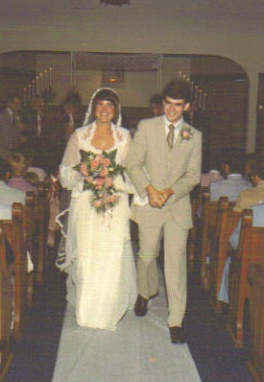
Our wedding day was delightful. Ninth Street Wesleyan Church in NewCastle, Indiana, was packed to the gills. The weather was hot, on the brink of a thunderstorm. Friends and family, college friends, and Church members were all in attendance.

Karen wore an off-white gown and carried peach-and-cream colored roses. I wore a tan suit. The officiant was Rev. Dennis Hilton, whose wife Barbara was the organist. Our soloist was Andrea Campbell. The Maid of Honor was Donna Martz, who is now Mrs. Mark Ferrebee, and the Best Man was Mike Wagner, who now teaches English in Japan.

We were married under a chupah, in celebration of our special dinners made in celebration of Jewish holidays and a tip of the hat to my Old Testament emphasis as a Bible major at Anderson College.

The 25 years that have followed have been high and low and everything in between. We've grown very much together as a couple. I think this has happened because we have both also grown very much as individuals. (Note: This is not a reference to the weight we've gained over the years!)

Our children, Allison (20) and Alex (18), are no longer children. They are healthy, vibrant, intelligent and amazing young adults. For 20 of the past 25 years, a happy marriage has included happy parenting. Our dear friend Kay Eckelbarger wrote a card to us promising that "the next 25 years are easier." I wondered if that had any reference to the absence of child rearing and the promise of grandparenting (we hope!).

What do the next 25 years hold for us?

At supper out together on our anniversary, we decided that the next 25 years would be "skinny." All the weight we've gained (and lost and gained and lost) would go for good. When we got home, we finished off a Dairy Queen ice-cream cake.

Karen's talked about finally working on her master's degree, getting specialized training for special needs children. I'm going to finish (and publish) my first novel.

We're going to stay in Roann. No, we're not. We're moving to North Manchester. No, wait: we're staying in Roann. Oops, nope: we're moving to North Manchester. Wait, wait. We're staying in Roann. Well, now that I think of it, we're going to move. Then again . . .

We hope to be grandparents, so we can make amends for all the mistakes we made the first time around. (Is this the second time I've mentioned grandchildren?)

Most of all, we want to be there for each other for the next 25 years, 'to have and to hold, etc., etc.' To represent this, our dear friend Marge Johnson gave us a salt shaker, emblazoned with silver bells and ribbons, and the simple message, "25th."

She said we'll get the pepper shaker on our 50th anniversary.

Friday, May 12, 2006

Halden Wofford and the Hi-Beams


I can't remember the last time I bought music by anyone born after 1850 . . .about the closest is Le Carneval Des Animaux by Camille Saint-Saens (b. 1835).

I have never purchased country music. Never.

But a week ago on the Prairie Home Companion I heard music that made it seem as if my ears were hearing for the first time. More than music, I heard originality. I heard live instruments, played by real hands, in touch with real creative minds. I heard enthusiasm. I heard a group of guys just having fun making music.

I wanted to stop my car to get out and dance in the road.

The group is Halden Wofford and the Hi-Beams, a 'western swing' band from Fort Collins, Colo., that is "passionately committed to playing real country music" (from their website, www.hibeams.com).

Within days I had ordered and received their first (and, to date, only) CD. When it arrived, I listened and was hooked.

The CD is a marvelous mix of pure country music, a few western-style waltzes, laced with a yodel here, a love song there, and such quality as few musicians outside the classical world possess.

My favorites?

I'm partial to "Billings Bop," an all instrumental piece where all that's missing is a barn full of cowboys and cowgirls dancing the evening away.

I also like "Let's Make Believe." This is a love song. In the back of my mind I pictured Karen and me out under the western moon, slow-waltzing in the star-shine with an audience of tumbleweed and coyotes.

For fun, there's "(My Other Car's An) Appaloosa." The song's the story of a city-bound cowboy who trades his weekday suit for the weekend life of a cowboy. The tongue-in-cheek lyrics speak to anyone confined to the city life, longing for the open spaces of the great west.

The whole CD is great.

The Hi-Beams website reveals one more subtle thing about them that makes their music even more significant. Their music is available through local, independent music stores and vendors. They are not a big-box operation.

Keeping it real in their music and in their business. What a deal.

I hope you'll check out Halden Wofford and the Hi-Beams on their website, www.hibeams.com. You'll be able to listen to "Appaloosa" there and link to purchasing information. You won't regret it.

Thursday, April 27, 2006

New Blog for Questions and Answers


I've begun another blog intending to be a little more interactive than The Country Parson. I'm calling it, "Ask the Country Parson."

My intention is not to be the 'Answer Man,' but to bring about some discussion about things that I am asked all the time as a pastor. I'll share my perspective, and I'd like to encourage you to begin a dialogue through the Comments Section that might generate personal and spiritual growth for everyone.

I'm looking forward to hearing from you.

Brian

Wednesday, April 19, 2006

Living An Easter Life


Icon of St. Thomas the Apostle, Witness to the Resurrection of Jesus Christ

Sermon notes from Easter Sunday, April 16, 2006

Epistle: I Corinthians 15:12-28, 50-58
Psalm: 100
Gospel: Luke 24:1-12

Alleluia! Christ is Risen!
He is Risen, indeed! Alleluia!

You and I are called to live an 'Easter life.'

We live in a world filled with despair, but we are called to an Easter life!

We know there are wars and violence, turmoil and disaster, but we are called to an Easter life!

We are faced with problems in our families, personal anxieties, abuse and addiction, and financial worries, but we are called to an Easter life!

In a world becoming increasingly secular and materialistic, we are called to an Easter life!

St. Paul's great affirmation in Romans 10:9 is the beginning of an Easter life: "If you confess with your mouth 'Jesus is Lord,' and believe in your heart that God raised Him from the dead, you shall be saved." In our Epistle this morning, Paul likewise proclaims, "If Christ is not risen, your faith is in vain . . .for as in Adam all die, even so in Christ shall all be made alive."

An Easter life is a life transformed, lived from the inside out, a life in which even death itself is no longer a threat.

An Easter life means that when we face despair, God gives us hope.
When we face war, God gives us peace.
When we face violence, God gives us comfort.
When we face turmoil, God gives us answers.
When we face disaster, God brings renewal.

In our homes, an Easter life means that no family problem is greater than the love of God to solve it.
No personal anxiety is as great as the care God has for you.
No amount of abuse can shake how much you are worth to God.
No addiction's chains are stronger than God's power to break them.
No financial worry is unnoticed by God, Who clothes the grasses and flowers of the field.

An Easter life sees what is Holy in a secular world: the holiness of every soul; the sacredness of God's world; the wisdom of our Heavenly Father. An Easter life holds on to what is Holy because it is True and Right and Beautiful and Good.

Living the Easter Life may lead to being misunderstood.
The Resurrection of Jesus Christ? To some, a myth.
New life in Christ? To many, a fantasy.
Hope for living? To others, 'rose colored glasses.'
Faith? To many, it's naive.
A changed life? Merely behavior modification.
Belief in God? A coping mechanism.
Confession of Faith? Mind control.

In spite of being misunderstood and scorned, rejected and made fun of, we know that we are living an Easter life, and that Christ is indeed, risen from the dead.

This morning, we are surrounded by symbols of this glorious Resurrection: the lilies trumpet the news; the candles in front of the Resurrection icon represent that the Light still shines in the world and that it cannot be overcome; the white cloth and paraments represent the New Life and a clean slate; and we received new members reminding us again that the Church continues from one age to the next.

In closing we will sing of yet another symbol of the Easter Life, The Lord of the Dance. Notice these words in the final verse:
They cut me down and I leapt up high,
I am the Life that will never, never die;
I'll live in you if you'll live in Me;
I am the Lord of the Dance, said He.

Dance, then, wherever you may be,
I am the Lord of the Dance, said He;
And I'll lead you all, wherever you may be,
And I'll lead you all in the Dance, said He.

Alleluia! Christ is Risen!
He is Risen, indeed! Alleluia!

Monday, March 06, 2006

The Dying Art of Singing

A week ago I went to a funeral for one of the best singers I've ever known. Marlin wasn't a widely known singer outside his Church circles, but he was widely known within it. He wasn't the best voice I've ever heard, but when Marlin sang, you could hear the best of him in his voice.

In Marlin's funeral there was plenty of singing: a French hymn with esoteric melodies, an old favorite (Wonderful Grace of Jesus) and two Church of the Brethren standards, including "Move in Our Midst." The congregation made the rafters ring. Marlin had been music director for 30 years in the same Church where his funeral took place. The Church Choir, including veterans from his own years as director, and the Timbercrest Choir, a choir Marlin cultivated for years in the retirement community where he lived, were outstanding in their choral remembrance. I haven't heard singing like that in a long time.

Even in my own Church, singing seems often more awkwardly dutiful than from the heart. It seems that many Churches have run headlong into the inane practice of singing off overhead screens without hymnals. (Canned music seems to often accompany . . . and cue the lights, please!) Even worse has been the move to 'entertainment' singing in Churches, where a worship band 'leads worship' and the congregation kind of jives along. (Can lighters for the end of the worship service - with Church logos on them - be too far behind?)

Singing from the heart is one of God's gifts to Creation. Birds sing, obviously. But actually nearly "everything that has breath" sings. A song communicates what's in the heart - praise and adoration to God, love and adoration to other people, sentiments both joyful and grievous.

Everyone used to sing. Until the 1960's, nearly every classroom had a piano and every school had a music teacher. Every Church had a pianist and organist and choir. In taverns, people sang. In community halls, people sang. There was a 'national repertoire.' Who didn't know "I've Been Working on the Railroad" or "Clementine" or "She'll be Coming 'Round the Mountain"?

And of course, everyone sang "The Star-Spangled Banner" at ball games and other public affairs. Last time I was at a basketball game, I felt like I was the only one singing the National Anthem! My wife looked at me as if I were creating a scene.

I like to sing out. When I have a hymnal in my hands, I try to find my part. If I can't, I just sing along the melody. When I'm walking in the woods, I'll sing at the top of my lungs, so that God and the deer and squirrels can hear (and sing along?).

Why don't people sing anymore? I have three observations. These are not scientifically researched or authoritative. They may even seem obvious. But here they are anyhow.

First, I think many people have lost a reason to sing. It seems like our culture spends so much time dwelling on our own angst that we don't have time to dwell on how great life is and how much there is to sing about. Everyone has problems and I have problems, too. But I also see the beautiful sunrises and the wide open skies. I see beauty in people and joy in relationships. These are reasons alone to sing.

Second, I think many people think they can't sing. Just a week or so ago, when Don Knotts died, a radio commentor spoke about her favorite episode of The Andy Griffith Show, in which Barney Fife joins the Church choir but sings so awfully that he drowns out the other choir members. The great thing about it was that Barney seems totally unaware of his tin-ear. He just loved to sing. I think most people can sing better than they give themselves credit for. But their singing has to come from the heart - not from the voicebox.

Third, most contemporary music is not good for singing. When was the last time a group broke out singing anything written in the last 20 years? When did anyone's family gather around the piano, or on the porch with a guitar? Does anyone know all the words to their favorite hymns - or does anyone sing hymns anymore?

Re-discover singing! Go find a tune and sing out! Find two or three other people and sing as many verses as you can to "Clementine." Turn off the radio in your car or the TV in your family room and dust off a kids' songbook and sing a while.